
The quarter to June 30, 2026 was an eventful one for the gold sector. The sector entered the quarter with the gold price at around US$5,000/oz and the outbreak of the conflict with Iran. This added to the impact of higher long-term interest rates and a stronger US dollar, which sent the price below $4,000/oz, a level it has held, trading sideways since then, and only recently starting a climb towards $4,500/oz again. This saw the average realized gold price achieved by the major gold producers fall 7% to US$4,441/oz in 2Q26, and the juniors fall 9.5% to US$4,336/oz.
All-in sustaining costs (AISC) jumped in the quarter, as higher energy costs and the cost of and other inputs were impacted by the Iran conflict and the closure of the Strait of Hormuz shipping lanes. AISC jumped 9.5% to US$1,876/oz from 1Q26 and 22.5% from 2Q25 for the majors, but just 2% from 1Q26 and 13% from 2Q25 to US$1,934/oz for the mid-tier producers, many of whom (Alamos Gold (NYSE:AGI), Allied Gold (NYSE:AAUC), Artemis Gold (TSX:ARTG), Centerra Gold (NYSE:CGAU), DPM Metals (TSX:DPM) and Eldorado Gold (NYSE:EGO)) experienced declining AISC. Of the majors, only Agnico Eagle Mines (NYSE:AEM) saw its AISC fall in the quarter.
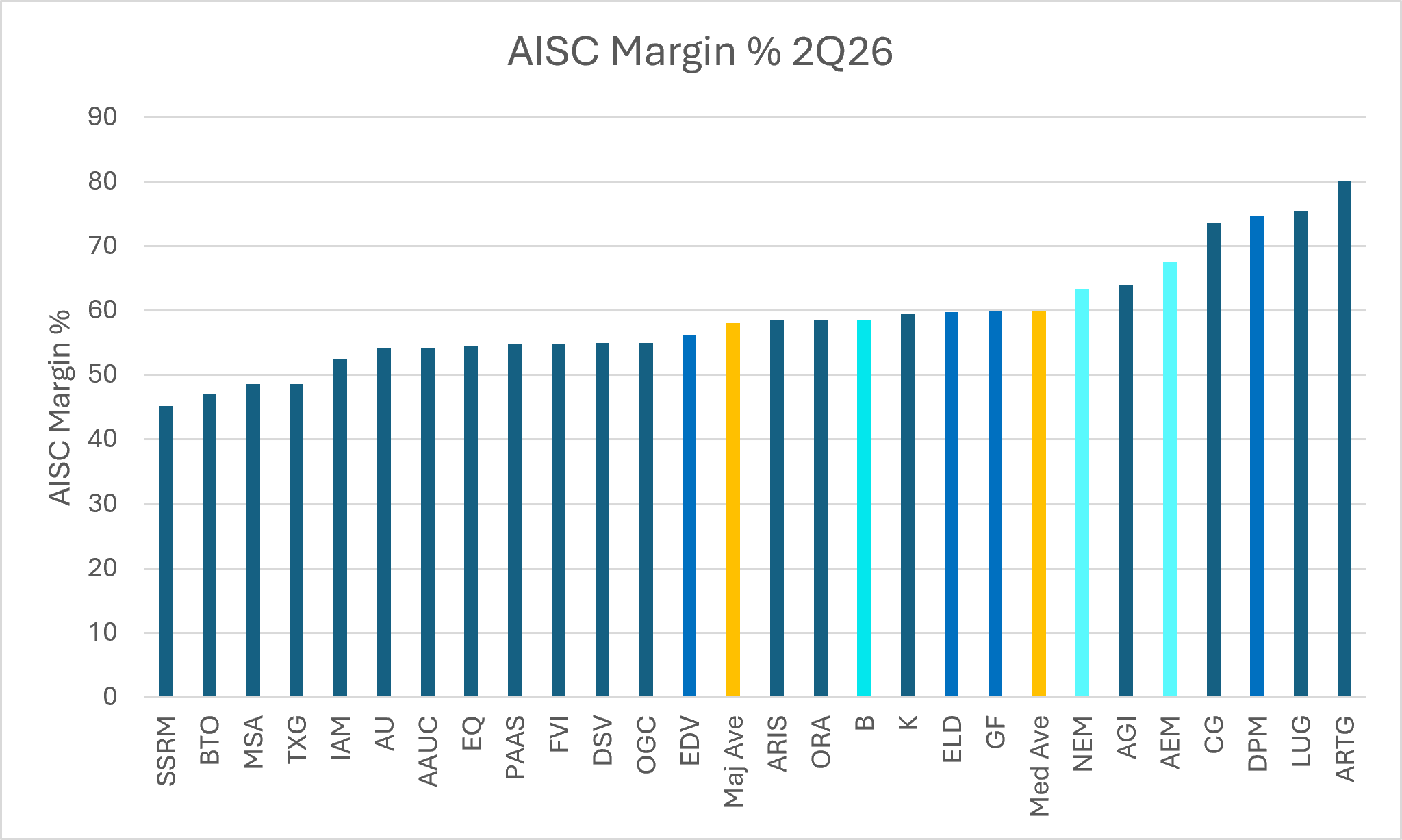
Exhibit 1: Goldco AISC Margins
Source: Company filings
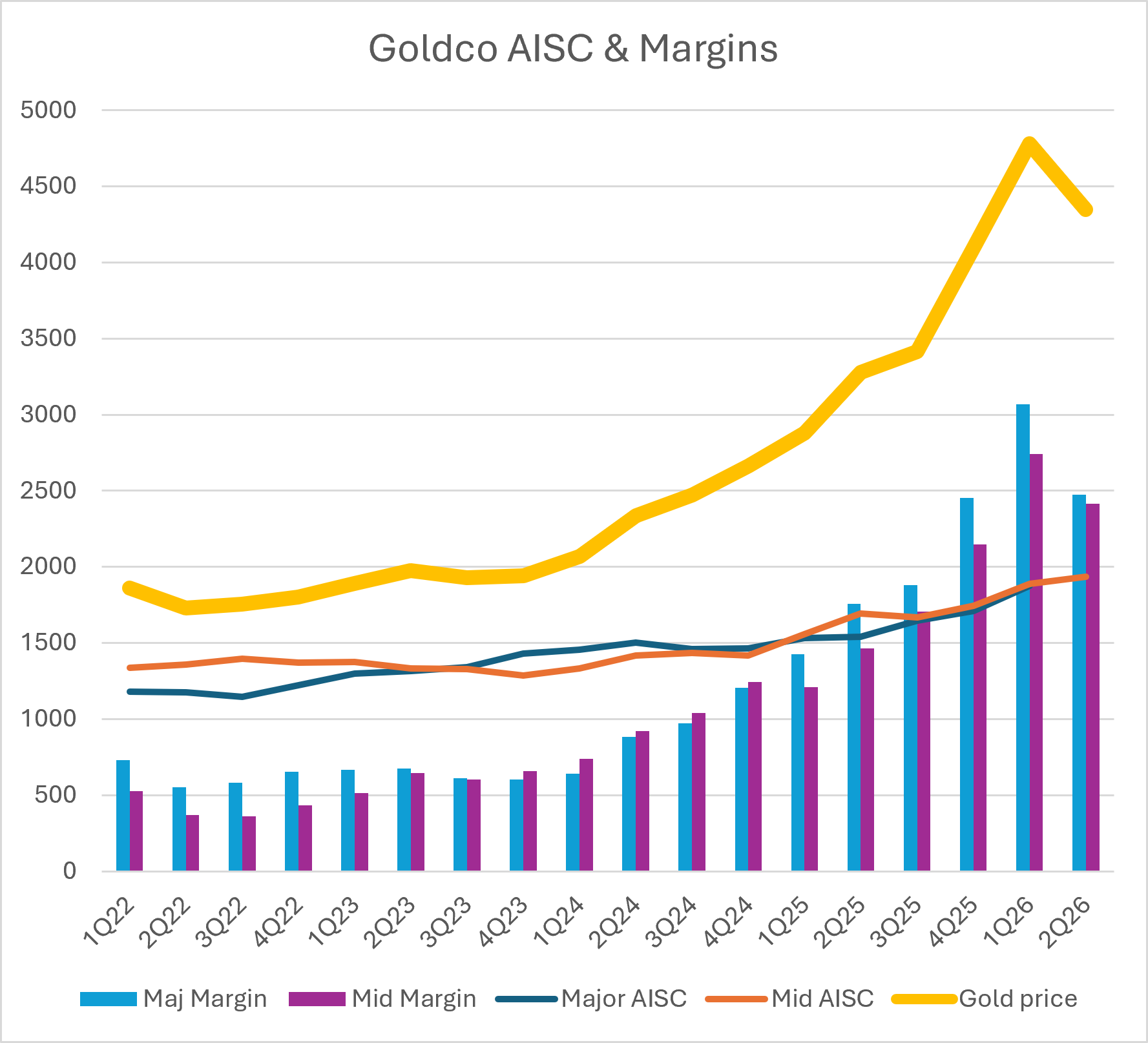
This resulted in the average all-in sustaining cost margin falling to 58% for the majors (see Exhibit 1), from 64% in 1Q26 and 53% in 2Q25, while the mid-tiers achieved 60% in 2Q25 from 59% in 1Q26 and 42% in 2Q25. Despite the falls, gold producers still enjoyed very attractive AISC margins of more than US$2,500/oz for the majors (see Exhibit 2) and more than US$2,400/oz for the mid-tiers.
Exhibit 2: Goldco AISC & Margins
Source: Company filings
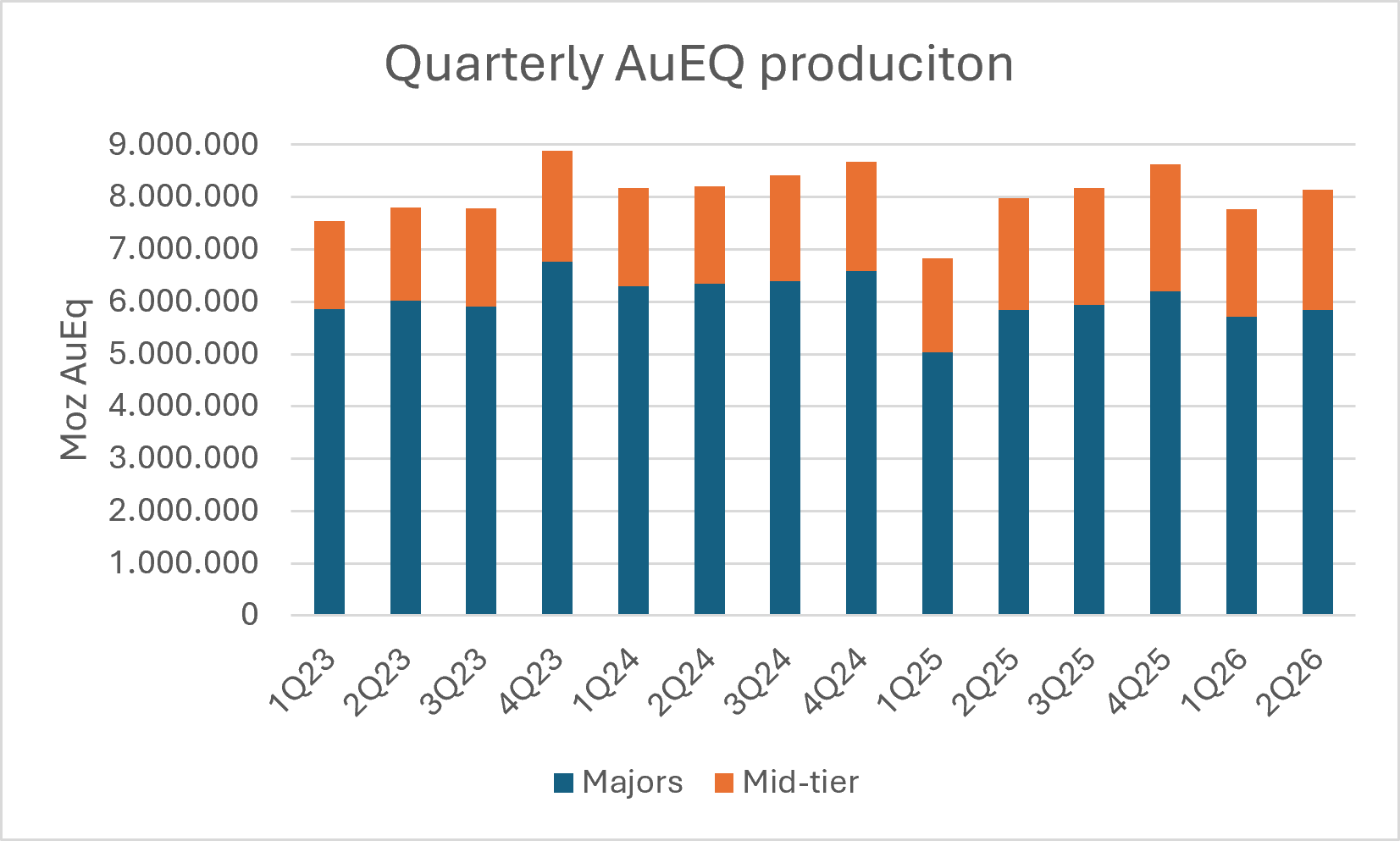
Aggregate gold production remains flat at 5.8Moz for the majors (See Exhibit 3) and 2.3Moz for the mid-tiers, although both were improvements over 1Q26 production, 2% for the majors and 16% for the mid-tiers.
Exhibit 3: Quarterly AuEq Production
Source: Company filings
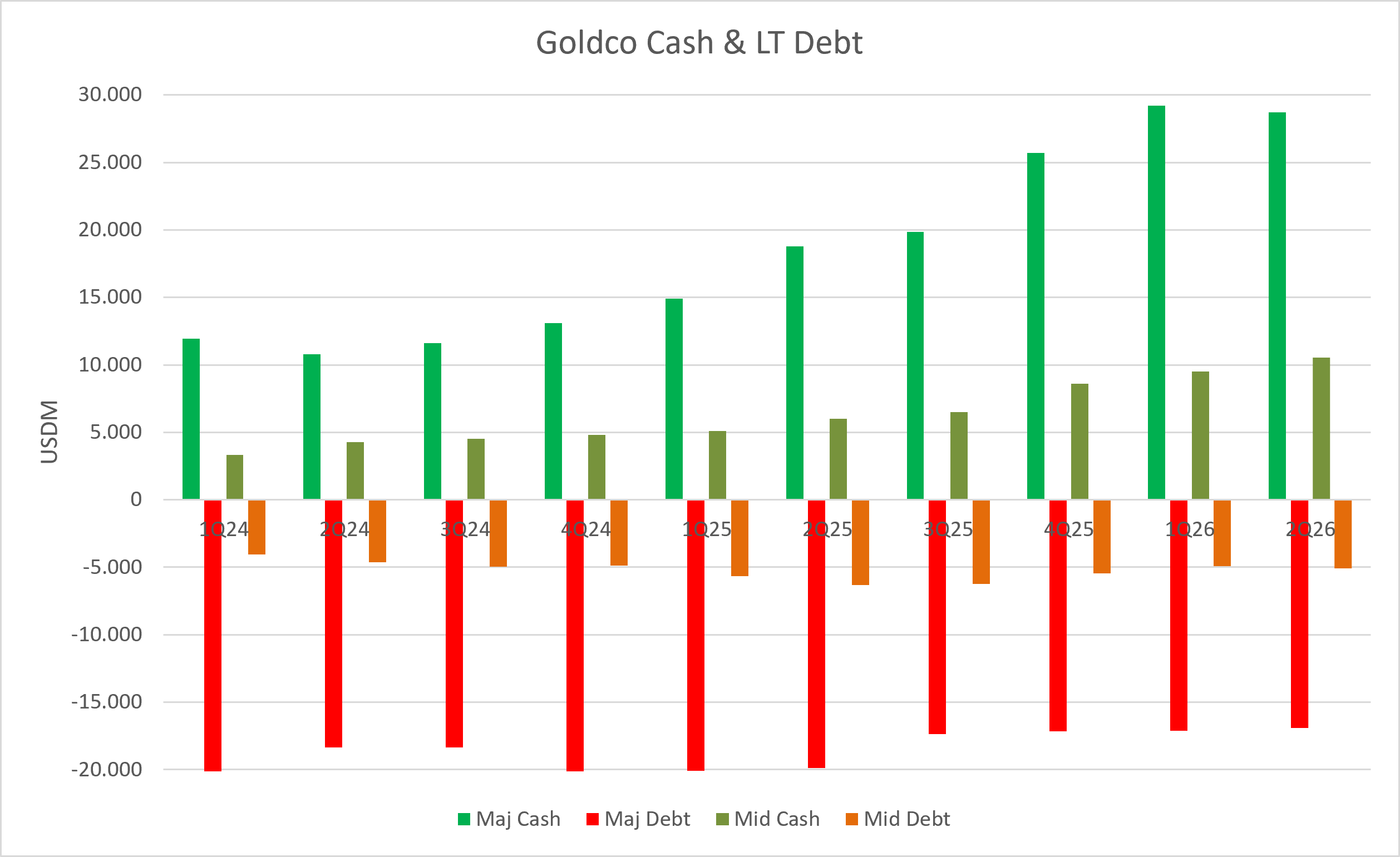
Gold producers are experiencing a cash bonanza, with cash on the balance sheet totalling US$29B for the majors and US$10.5B for the mid-tiers (see Exhibit 4), and long-term debt continuing to reduce to US$16.9B for the majors and US$5B for the mid-tiers. Several mid-tiers have no long-term debt: Allied Gold, Centerra Gold, DPM Metals, Discovery Mining (TSX:DSV), Lundin Gold (TSX:LUG), Oceanagold (NYSE:OGC), SSR Mining (NASDAQ:SSRM) and Torex Gold (TSX:TXG).
Exhibit 4: Goldco Cash & LT Debt
Source: Company filings
Much of the long-term debt carried by the majors carries modest coupons and is spread over several years, hence their reluctance to pay it down more rapidly. They are all in a net debt-positive position (cash minus long-term debt), with the exception of B2Gold (NYSE-A:BTG). The majors generated more than US$6B in aggregate free cash flow; the mid-tiers, more than US$1.5B.
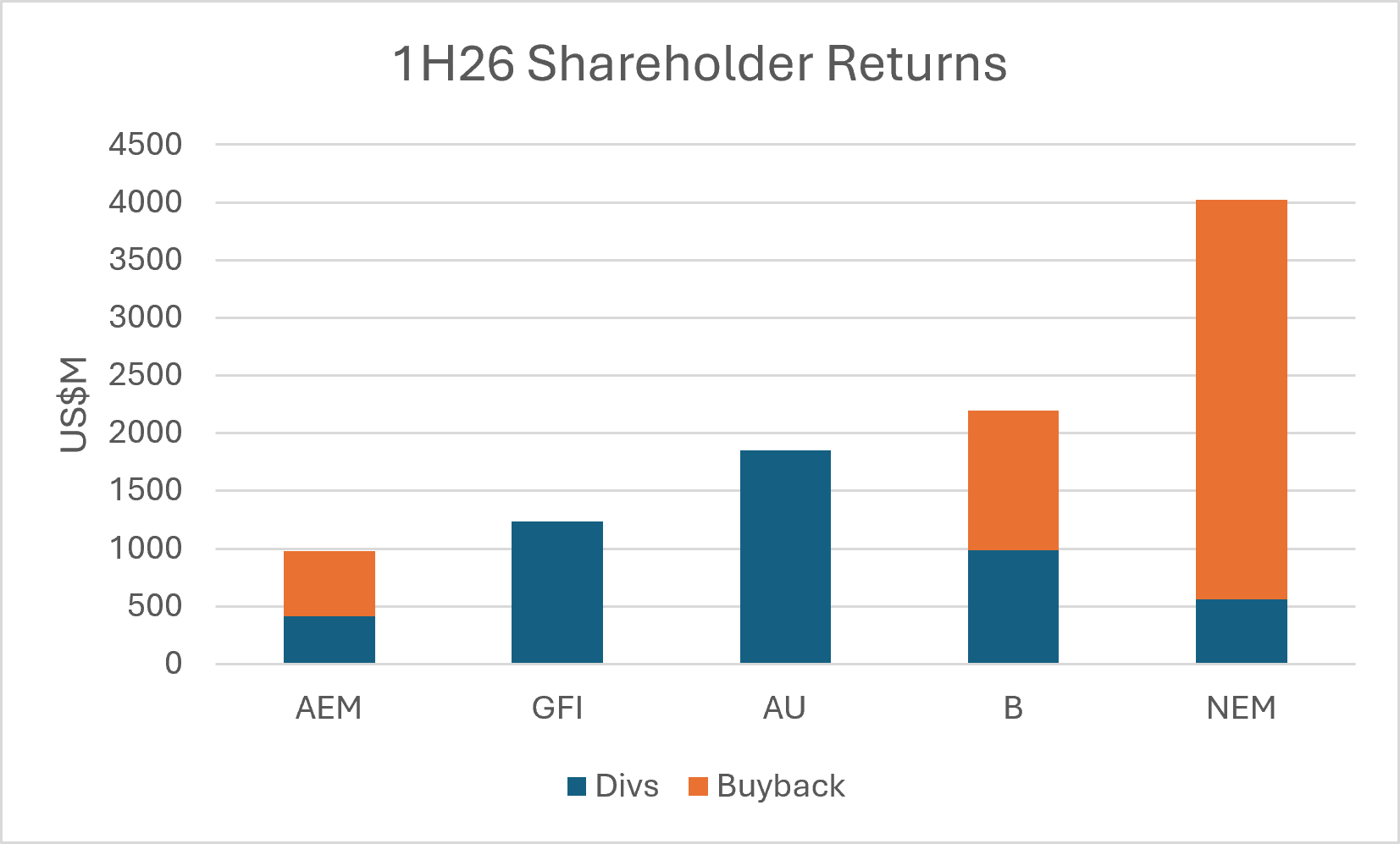
Exhibit 5: 1H26 Shareholder Returns
Source: Company filings
With balance sheets in perhaps the best condition they have ever been, returns to shareholders remain a strong part of company policy. So far in 2026, companies in the sector have returned more than US$14.8B to shareholders, representing more than 84% of free cash flow, with US$7.8B in buybacks and US$6.9B in dividends. Newmont leads the field with US$4B so far this year (see Exhibit 5), followed by Barrick Mining (NYSE:B) US$2.2B, AngloGold Ashanti (NYSE:AU) US$1.9B, Gold Fields (NYSE:GFI) US$1.2B, and Agnico US$1B.
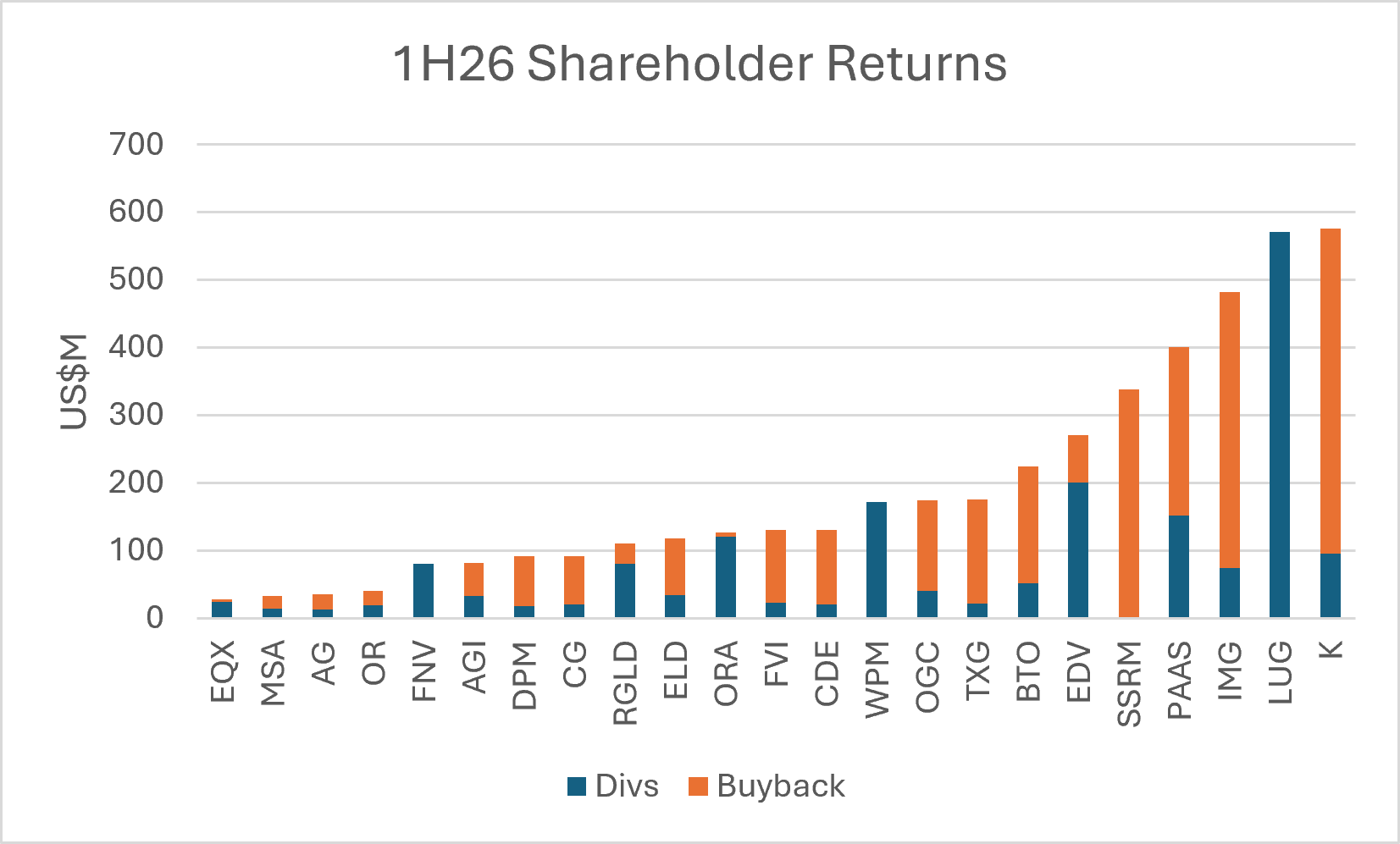
Exhibit 6: 1H26 Shareholder Returns
Source: Company filings
There are some very aggressive share buyback policies being executed, notably by Newmont and many mid-tier producers (see Exhibit 6). Buybacks serve several functions. Companies file them under returning capital to shareholders, albeit to shareholders who are quitting their investment in the company rather than that capital going to ongoing shareholders. However, ongoing shareholders benefit from there being fewer shares outstanding, which, ceterus paraibus, should ultimately translate into a high price for the shares they own. However, having fewer shares outstanding also means management can post improving per-share metrics even though their actions may not have improved de facto performance.
A concern for many sector observers is that production remains flat, and with project development timescales growing and project costs increasing, this trend is likely to persist. Miners exploit a depleting resource, and so they must advance growth initiatives. This means that at some point, many companies will have to embrace M&A just to stand still, let alone grow. For now though, most producers are in a healthy balance sheet position, are getting healthier by the quarter, and increasingly sharing the benefits of that health with their shareholders.
Battle Bank is the very best! TY Rick....how come you never mention anything about MUX?
Sir
Thank you
You have mentioned elsewhere that in good time miners prefer to extract lower grade deposit.
Is it something that can explain higher asics too ?
Is it not good for gold that the production stay flat overall ?
Gold has to stay energy intensive in any circonstances ?
Respectfully
Jerome