
Rule Symposium highlights 2026
Rule Investment Newsletter #17
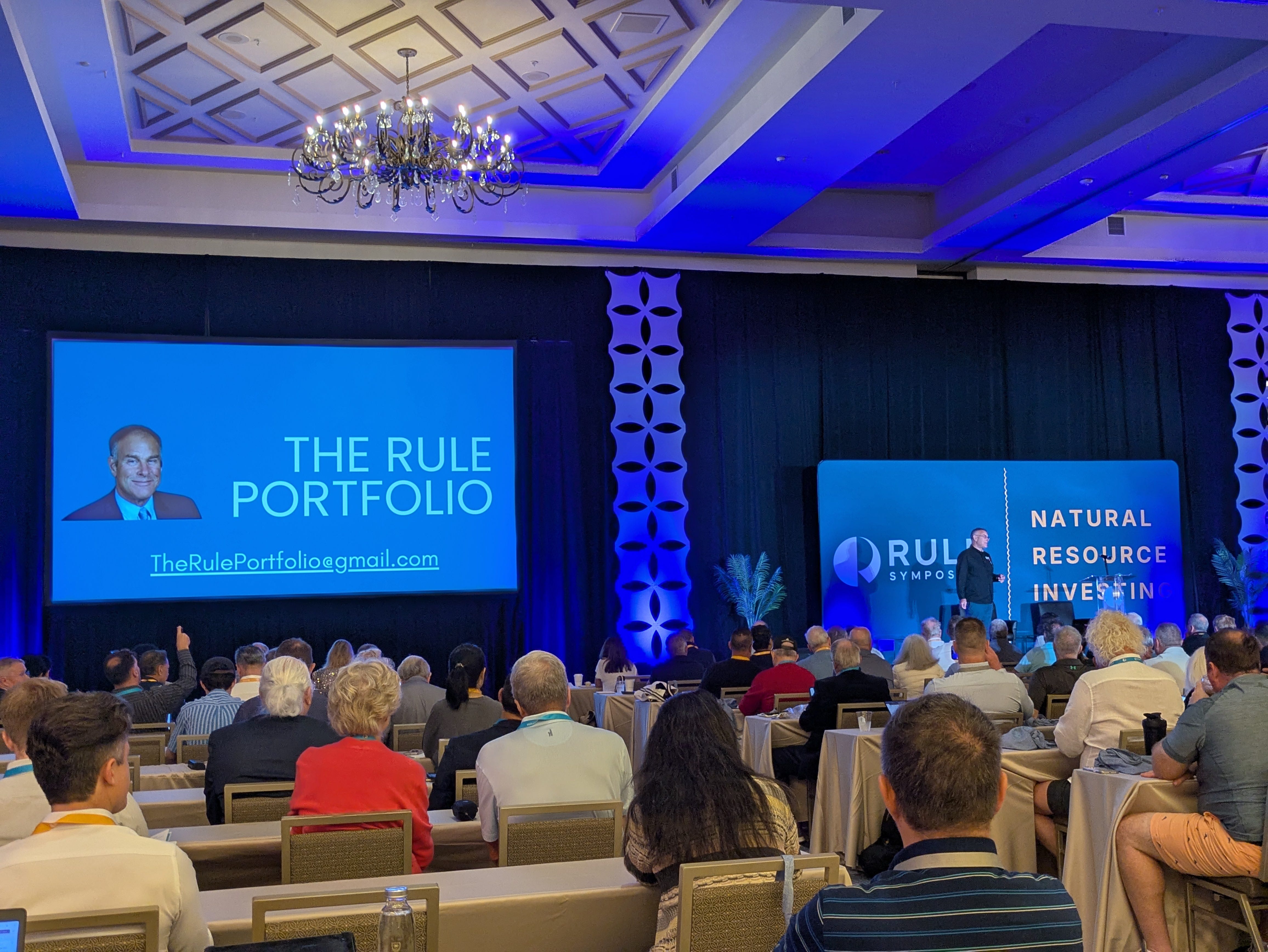
With some 1,000 retail investors in person at the 2026 Rule Symposium in Boca Raton, Florida, this week, and another 2,200 tuning into the livestream hosted by Paul Harris, event host Rick Rule commented that after about 35 years and various iterations, the event has finally developed into the investment community he hoped it would. A show of hands indicated that many attendees were participating for the first time, and the heavy traffic at the 65 booths suggested they were there for more than a bit of July sun.
The 2026 Rule Symposium in person sold out rapidly so sign up soon to be at the 2027 Rule Symposium 5-9 July, at The Boca Raton.
With a ~30% decline in the gold price since hitting an all-time high at the start of the year, and a ~50% decline in the silver price, a key question for many delegates was, is this a necessary and healthy pullback in a continuing bull market, or something more permanent. The keynote speakers viewed it as the former and a buying opportunity, although Rick Rule expects the market to be soft and trading sideways for the next couple of months.
Further down, you will find links to some of the standout keynote presentations and the bonus live stream content interviews conducted by Paul Harris.
The Rule Portfolio
Rick took the opportunity to announce that he will launch a premium newsletter about a new, actively managed investment account, in which he will share the trades he makes and the rationale behind them with subscribers, including his thoughts on portfolio construction and risk management. Anyone interested in subscribing should write to:
TheRulePortfolio@gmail.com
We intend that Rick’s private placement participation will be one of the elements included in The Rule Portfolio. Nick Hodge of Digest Publishing spoke about the private placement edge. Hodge said that investing in private placements allows qualified accredited investors to invest ahead of the crowd with a select group of investors, such as Rick, and directly provide capital to the companies that need it. Other benefits are that private placements are often priced at a discount to the market price, and often come with a full or half warrent, both of which increase the opportunity to make a return on your investment. Here is Rick on warrants:
“A warrant is the reward for the investor taking the risk to provide capital to a company. Its pricing should reflect the specific risk, while the duration of the warrant should refelct the time the company will need to use the funds raised to answer the unanswered qestion.”
Volatility
Rule Symposium delegates heard that volatility is expected to continue. Brien Lundin, editor of The Gold Report, welcomed the pullback in metals prices in March as the first real correction in this bull market and promised more to come. Here is Lundin:
“We are going to have furious rallies and nerve-wracking corrections like this.”
Lundin brave enough, however, to state that at $4,000/oz, he thinks the gold price has bottomed. Adrian Day of Adrian Day Asset Management was not so sure and thinks it could test $3,600/oz, with $4,000/oz being a typical mid-cycle correction, with the metal price “just resting”. Here is Adrian:
“All of the drivers that have made gold go up are still intact.”
The pullback in metals prices and consequent pullback in share prices meant many CEOs may have legitimate claims to being undervalued. Adrian Day agrees, commenting on stocks being down 40% from their peak, valuations being low, and sentiment being extremely weak:
“There is an incredible setup for a strong rally at some point.”
CEOs saying that their companies are undervalued is a cliché and part of their job, but as Justin Tolman of Sprott Asset Management observed during his live stream interview with Paul Harris with the sang froid of someone whose job is to kick the tyres on investment opportunities and develop his own valuation models:
“Cheap does not mean mispriced”
Further down, you will find links to some of the keynote presentations, and the bonus material from the live stream interviews conducted by Paul Harris.
For those of you reading this who think you missed the 2026 Rule Symposium, think again, because the entire event was filmed and the recordings will be available until the end of the year. This means you can still register to see the content by clicking the link below:
Big Picture Themes
A number of keynote speakers gave their views on big picture themes concerning the macro environment, including the US dollar, central bank gold buying, interest rates and geopolitical risks. Grant Williams, for example, observed that the US dollar is on its way to becoming worthless as the US debt pile increases and its purchasing power slides.
Cry Wolf …Again
GRant Williams reprised his 2018 presentation in which he used the reintroduction of wolves into Yellowstone National Park, as a metaphor for the role gold plays to ensure a healthy financial ecosystem. Williams suggested a new gold standard is being imposed by markets, as gold is all that’s left when everything else fails. Evidence is the continued buying of gold bullion by central banks, in part because of the weaponization of the US dollar, with central bank buying at fastest rate in 60 years. China has been a net buyer for 20 consecutive months.
“Every financial system needs the apex predator that keeps it functioning properly. Gold is the apex predator atop the financial food chain.”
Giving even more food for thought Williams observed that:
“US debt in dollar terms has grown 60,000,000% since 1850. Expressed in gold, it has grown by 260,000% or 0.4% of the increase in US dollar denominated debt. With $1.3T spent on debt interest costs in 2025, and this forecast to increase to $2.1T by 2036, that means $15,600 per household to cover interest by 2036 from $9,600 2026.
Dr Nomi Prins, Prinsights Global
Dr Prins spoke of a super cycle of commodities, as geopolitical competition for critical minerals will result in government actions that spike prices in a similar way that the closure of the Straight of Hormuz spiked the oil price earlier this year. Prins sees copper as being exposure to geopolitical interference through Trump tariffs and restrictive measures by China, which is also being seen in rare earths and tungsten, among other commodities. Here is Dr Prins:
“We are in a major multi century pinnacle of a super cycle in commodities”
Here is Rick Rule’s view:
“We are in a multi-year, perhaps decade-long bull market in precious metals and natural resources, but the next few months will be soft. We will see constant or higher interest rates in the US. Good assets get shaken out of weak hands into strong hands. When you see a sign that says sale, go towards it not away from it. The key determinant of gold prices is investors and savers confidence or nervousness about the maintenance of their purchasing power in conventional assets and in real interest rates. In the 1970s, the dollar lost 75% of purchasing power in a decade. If past is prologue, gold will maintain its purchasing power in a world where the dollar loses 75% of its purchasing power. If you save in gold, you are astonished how cheap things have become over the past 25 years.”
Professor Joel Litman, CIO, Altimetry Research
Professor Litman provided a contrarian view of the US stock market in that he believes the data shows that it is not overheating. He said corporate America has a 19.7x price to earnings, and a 19x growth rate which gives a PEEG (price to earnings divided by earnings growth) of 1:
“Corp America is not in a bubble. … If you have money that is passive and don’t need it for hte next 10 years, this is a cheap market.”
Professor Litman also said that the growing income of the US government, o nthe back of growing corporate profits and therefore taxation, means that it is more than capable of finaning its growing debt:
“Goverments are powered by taxes, so GDP is a very poor measure of tax power. US corporate taxes and wages will bring in US$5.6T in estimated tax revenue this year. Federal tax revenue is going up faster than social security payments and faster than the net interest payments on debt. Will tax revenue continue to be able to service US expenses? As long as the US fed tax revenue increases every year by $100B, the government can run a deficit each year of $2T and still have a Triple A credit risk rating. The cushion is getting better, not weaker.”
Buying Opportunity
Rick said that money is made in the delta between price and value, and that mid-tier miners are selling at a discount to their valuations. In turn, this could stoke a boom in M&A activity, both because of a chronic under investment in exploration which means companies need to buy ounces in the ground to maintain their production profiles, but also because the valuation gap between the biggest and best companies and the rest is widening. This is a viewpoint that mining lenged Rob McEwen agrees with:
“Wall St will ask producers to grow, and the only way is acquisitions. Takeovers are a huge deal going forward. There is going to be an orgy of M&A, and there will be eye-popping multiples.”
Livestream links
Rob McEwen, McEwen Inc
Adrian Day, Adrian Day Asset Management
Prof Joel Litman, Altimetry Research
Joe Mazumdar, Exploration Insights
Dr Steve Enders, Brooks & Nelson livestream
Quinton Hennigh, San Cristobal Mining
Adam Taggart, Thoughtful Money
Joeseph Cavetoni, World Gold Council
Lynette Zang, Zang International
Matthew Peipenburg, Von Greyerz
Keith Hill, NG Energy International
Select Keynote links
Adrian Day, Adrian Day Asset Management
Andy Schectman, Miles Franklin Precious Metals
Prof Joel Litman CIO Altimetry Research
Joseph Cavetoni, World Gold Council